
Automatic vs Quartz Watches: Why Mechanical Timepieces Still Matter
- Carola de Witt

- 1 day ago
- 5 min read
The Eternal Battle on the Wrist. The debate between automatic vs quartz watches has fascinated collectors for decades. From the Quartz Crisis of the 1970s to the modern revival of mechanical craftsmanship; discover why automatic watches continue to fascinate in a digital world dominated by precision and convenience.

Introduction: More Than Just Telling Time
Time has always fascinated humanity.
Long before smartphones and digital screens measured every second of our day, people searched for ways to capture time itself.
First through sundials.
Then pocket watches.
Eventually the mechanical wristwatch.
For decades, a watch was more than an accessory. It was an instrument of trust.
Pilots relied on them in the cockpit. Divers depended on them underwater. Sailors used them while navigating open seas where precision could mean the difference between safety and disaster.

Then, in the 1970s, everything changed.
A technological revolution arrived that almost made the mechanical watch disappear forever. And yet, despite living in the most digital era in history, automatic watches are not only still alive today, they are more appreciated than ever.
So why does the battle between quartz and automatic watches still matter?
Because the debate is no longer only about telling time.
It is about how you choose to experience it.
"A watch was never purely about practicallity"
The Quartz Crisis That Changed Watchmaking Forever
For centuries, every serious watch was mechanical.
Swiss watchmakers perfected the art of tiny gears, springs, and hand-assembled movements over generations. Mechanical precision was considered the highest form of engineering craftsmanship. Then, in 1969, Seiko introduced the world’s first quartz wristwatch: the Astron. It looked innocent enough.
But inside was technology that changed the industry forever.
Instead of relying on a mechanical movement powered by springs, quartz watches used a battery and a vibrating quartz crystal to regulate time with astonishing accuracy.
Why Quartz Watches Took Over
The advantages were immediate.
More accurate
Cheaper to produce
Easier to maintain
Simpler to mass-produce
Consumers embraced them almost overnight.
For the traditional Swiss watch industry, the impact was devastating.
Thousands of watchmakers lost their jobs. Historic manufacturers disappeared. Mechanical watches suddenly seemed outdated beautiful perhaps, but obsolete.
This period became known as the Quartz Crisis.
And for a moment, it truly felt like the age of the mechanical watch had come to an end.
But something unexpected happened.
Mechanical watches survived.
Not because they were more practical.
But because people realized a watch was never purely about practicality.
Automatic vs Quartz Watches Explained
From a purely rational perspective, quartz watches are incredibly difficult to criticize.
They are remarkably accurate, often deviating only a few seconds per month.
They require little maintenance beyond changing a battery every few years, and they continue running effortlessly whether you wear them daily or leave them untouched in a drawer. Quartz democratized watchmaking. It made reliable timekeeping affordable and accessible to millions of people. And even today, for someone who values convenience above all else, quartz remains the logical choice.
The Advantages of Quartz
Exceptional accuracy
Affordable pricing
Minimal maintenance
Reliable everyday performance
Lightweight and practical
The Downsides of Quartz
Logic is rarely the reason enthusiasts fall in love with watches.
Because despite all their strengths, quartz watches often lack one thing collectors quietly search for: character.

A quartz movement is efficient, but emotionally distant.
The seconds hand jumps mechanically from marker to marker, and there is little sense of interaction between owner and object.
And perhaps most importantly: a quartz watch depends on a battery.
For many enthusiasts, that changes the entire experience.
Automatic Watches: Beautifully Imperfect
An automatic watch operates differently.
Instead of a battery, it relies on movement, your movement.
Inside the case, a rotor swings naturally as you wear the watch, winding a mainspring that stores energy and powers the movement itself.
You can feel it working. You hear the subtle ticking in a quiet room. You notice the smooth sweep of the seconds hand gliding rather than jumping. You become aware that something mechanical is alive beneath the dial.

The Advantages of Automatic Watches
Mechanical craftsmanship
Smooth sweeping seconds hand
Emotional ownership experience
Long-term collectability
Traditional watchmaking heritage
The Downsides of Automatic Watches
Of course, automatic watches come with compromises.
Less accurate than quartz
Require servicing over time
More expensive to produce
Need movement or winding to keep running
But perfection was never the point.
Mechanical watches are admired for the same reason people admire vintage sports cars, handcrafted leather goods, or fountain pens: not because they are the most efficient option, but because they create emotional connection through craftsmanship.
Why Choosing Mechanical Is a Statement
Today, nobody truly needs a mechanical watch.
Your phone is more accurate. Your smartwatch is more functional.
And yet automatic watches continue to thrive. That is because wearing a mechanical watch has become a quiet statement about values.

It says you appreciate:
craftsmanship over convenience,
longevity over disposability,
and character over pure efficiency.
A mechanical watch slows time down slightly in a world obsessed with speed.
It reminds its wearer that not everything valuable has to be optimized.
And What About Quartz at LIGURE?
A fair question.
As pragmatic watchmakers, we never say never. Time itself refuses to stand still, after all.
Perhaps one day a quartz-powered LIGURE may quietly dock at the harbor.
But for now? There is not a battery in sight.
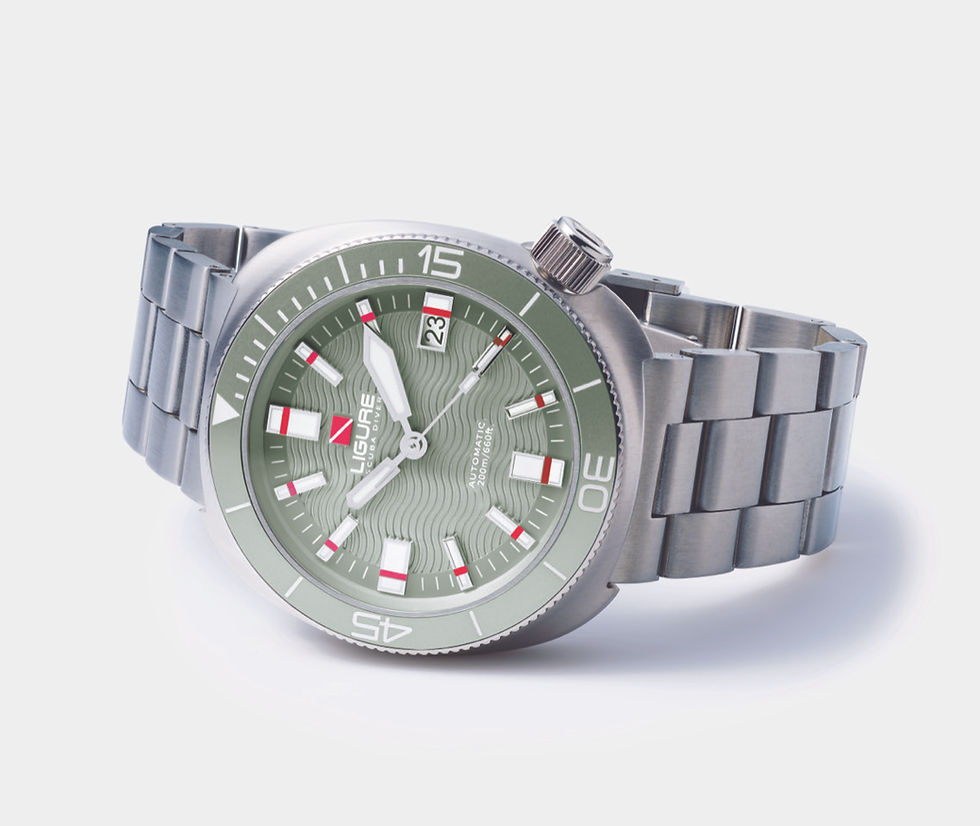
At LIGURE Watches, we remain hopelessly in love with the craft of the automatic movement. No electronic pulses. No silent circuit boards. Just gears, springs, motion, and the satisfying mechanical heartbeat that comes alive the moment you fasten the watch around your wrist. You could say quartz gives a watch energy. But automatic movements give it character. And honestly, we are simply not ready to trade romance for batteries yet.
Why Mechanical Watches Still Matter Today
Modern mechanical watchmaking survives because certain things cannot be replicated digitally:
tactile experience,
engineering beauty,
emotional permanence.
This is especially true for brands inspired by exploration, adventure, and maritime heritage. At LIGURE Watches, the focus on automatic movements reflects exactly that philosophy. The brand’s maritime Riviera DNA and adventurous character are rooted in the idea that true reliability comes from mechanical trust; the kind sailors, divers, and explorers depended on long before digital technology existed.
An automatic movement feels appropriate in that context. Not because it is the easiest solution. But because it embodies resilience, craftsmanship, and independence.
Conclusion: Quartz for the Clock, Mechanical for the Enthusiast
Quartz watches changed history because they made timekeeping accessible, affordable, and incredibly accurate. Mechanical watches survived because people discovered that watches were never only about accuracy.
Quartz is for the clock.
Mechanical is for the enthusiast.
Because in the end, the most beautiful watches were never designed merely to measure time; but to make us feel connected to it.

Continue the Journey
Explore the automatic collections of LIGURE Watches.


Comments