
The Engineering Anatomy of an Automatic Dive Watch: Why 20 ATM and Details Matter
- Carola de Witt

- Mar 18
- 4 min read
A dive watch is more than just a tool for telling time; it is a technical feat engineered to survive one of the most unforgiving environments on Earth. Whether you are exploring the depths of the Ligurian Sea or simply appreciate the aesthetics of a robust timepiece, the true quality lies in the details that might not be visible at first glance.
At Ligure, we believe a watch should support its wearer with unfailing precision. But what exactly makes a watch truly "depth-ready"?

The "Desk Diver": Corporate Adventures
Let’s be honest: most of our watches see boardroom tables more often than coral reefs. In the watch community, we affectionately call this the "Desk Diver." This is the adventurer who dives deep into spreadsheets, survives the crushing pressure of tight deadlines, and whose greatest water hazard is the office coffee machine. But that’s exactly the appeal. You don’t wear a serious dive watch just for the depths; you wear it for the confidence of knowing you could handle them if you had to. Whether you’re descending 20 meters below or simply making a sporty statement at your desk: the engineering needs to be bulletproof. Let’s look at what’s under the hood of these powerhouses.
"most of our watches see boardroom tables more often than coral reefs"
1. Dive watch engineering and water resistance: The line between fashion and a 20 ATM Instrument
In the watch world, water resistance is often expressed in meters, but this can be misleading. A watch marked 30m or 50m is splash-proof at best, but it won’t withstand the pressure of open water.
For a serious dive watch, 20 ATM (200 meters) is the gold standard. This number represents not just depth, but the static pressure the case can withstand. When designing our watches, we focus on the integrity of the construction:
The Screw-Down Crown: This is the primary barrier against moisture. By literally screwing the crown into the case, the gaskets are compressed into a watertight seal.
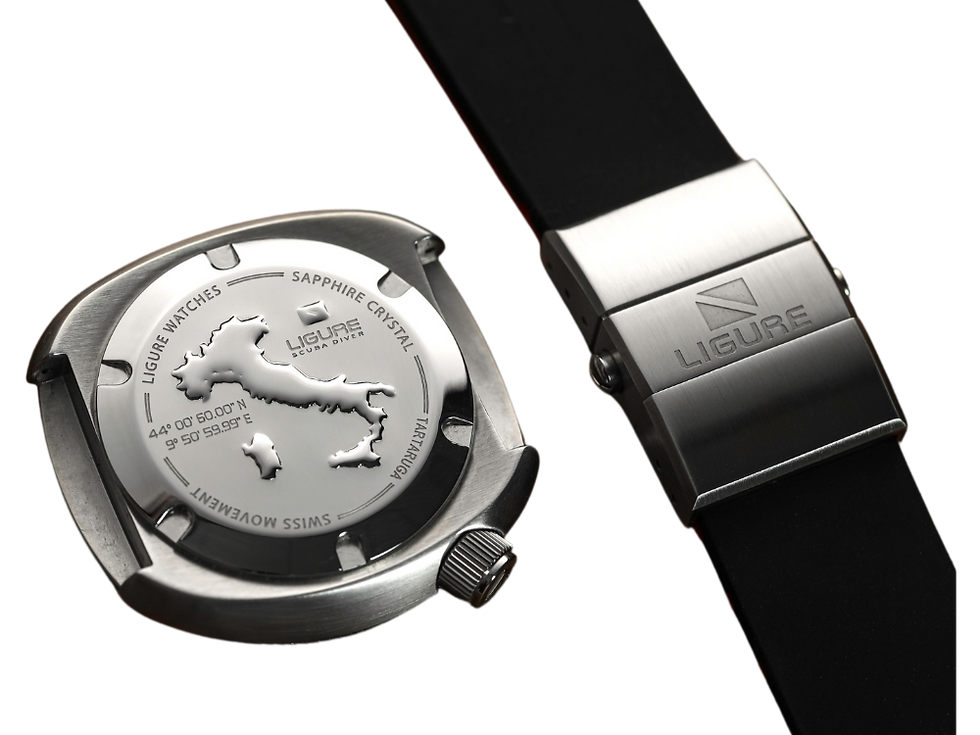
The Case Back: A solid, screw-down case back ensures the watch does not deform under the immense pressure found at greater depths.
When you choose a timepiece built to these specifications, you are choosing the peace of mind that the movement inside is protected, regardless of the conditions above or below sea level.
2. The Unidirectional Bezel: How a Diver's Rotating Ring Provides an Analog Backup
One of the most recognizable features of dive watch engineering is the rotating ring around the crystal: the bezel. In an era of digital dive computers, this remains a crucial analog backup for every diver.
Why does the bezel only rotate in one direction (counter-clockwise)?
Safety First: The bezel is used to track elapsed dive time. If you accidentally bump the bezel against your gear or a rock, the indicated dive time can only appear shorter, never longer. This prevents a diver from mistakenly thinking they have more oxygen left than they actually do.
Tactile Feedback: The "click" of the bezel must be crisp and precise. It is the feeling of mechanical perfection that builds confidence before you even hit the water.

3. Automatic Dive Watch Mechanics: The Heartbeat of Craftsmanship
Why do enthusiasts prefer a mechanical, automatic movement over a standard battery-powered watch? The answer lies in the soul of the instrument.
Independence: You are never dependent on a battery that could fail. An automatic watch winds itself through the natural motion of your wrist.
Longevity: At Ligure, we select movements that are not only accurate but robust enough to handle the vibrations and shocks of an active lifestyle.
The Sweeping Motion: The seconds hand of a mechanical watch glides across the dial, a visual testament to hundreds of fine components working in perfect harmony.

4. Swiss Super-LumiNova: Visibility in the Deepest Dark
As soon as you descend below the surface, light behaves differently. This is where the role of luminous pigments becomes vital.
The Power of High-Grade Pigments
We utilize high-grade pigments that store sunlight and emit a long-lasting glow in the dark. This isn't just an aesthetic choice; it is a functional necessity for a diver who needs to read their dive time at a single glance.
Contrast and Clarity
Beyond light output, contrast is essential. A deep, matte dial ensures that hands and indices stand out sharply, reducing reflections to a minimum.
5. Premium Materials: The Role of 316L Steel and Sapphire Crystal in a Robust Tool Watch
A watch bearing the Ligure name must withstand saltwater, sweat, and UV radiation.
316L Stainless Steel: Also known as surgical-grade steel. It offers the perfect balance between hardness and corrosion resistance.
Sapphire Crystal: Sapphire is nearly as hard as diamond, ensuring a permanently clear view of the time without the risk of scratches.

Ready for Your Next Adventure?
A watch is more than the sum of its parts. It is the combination of technical choices, material quality, and a deep-rooted passion for the sea. When designing our collections, we are guided by these principles: no compromises on robustness and a sharp eye for detail.
Curious how we translated these technical specifications into our Tartaruga collections?


Comments